Dear parents, this is one of the most engaging topics that every parent wants to understand for the betterment of their child. If we honestly accept this fact that most children develop some kind of fear of Maths during their growing years, then we can go deeper to understand the reasons and take corrective (or preventive) measures at the right time. As a chief trainer of Mathcruise, I feel blessed to have a rich experience of more than 10 years of teaching Maths to young kids as a result of which I have seen that many children struggle with Maths in absence of professional support. Our goal is to remove fear of Maths from the mind of these young kids and turn Maths into their favorite subject.
Let us break this topic into smaller parts below for a step by step approach.
Why Do Kids Develop Fear of Maths?
Usually the reasons why kids develop fear of Maths are common for most kids. I personally believe that most of these reasons have to do with our social setup and the way schools follow the academic approach.
- Lack of basic understanding of Math concepts – Due to multiple reasons ,for example the huge number of students in a single class in the school (often ranging upto 45 students in India), or the constraints with the teacher that they cannot slow down since they have to complete the syllabus within fixed time, many times the child does not clearly understand simple concepts like addition, subtraction, tables, or fractions. We must accept the harsh fact that young kids often feel shy to ask their doubts in class, and they will surely never ask the teacher to slow down. As a result, the moment your child does not understand any basic concept, all the subsequent topics taught after that are built on a weak foundation since every topic in Maths is generally dependent on the earlier concept. Hence advanced topics become much harder to understand.
- Role of society – As a society, both parents and teachers also play an important role. It is not uncommon to hear adults make statements like “Maths is difficult” or “we were never good at maths”. Children hear these words and unfortunately they imprint the same impression in their mind, and as a result they start believing that maths is naturally tough which is not true
- Over dependency on the use of calculators – We often see students using calculators starting at a young age. Therefore, the child cannot even perform simple math operations without the use of a calculator. He never manages to establish a solid grasp on numbers or the basic arithmetic operations like addition and multiplication. In the regular school classes or exams, since calculators are not allowed, he ends up consuming a lot of time in doing calculations and as a result not able to focus on the actual concepts or problem solving. On the other hand, if a child learns through Abacus classes online and can perform calculations really fast (using mental Maths techniques like Abacus or Vedic Maths), they can pay more attention to the core topics taught by teachers, as well as focus on real problem-solving in exams, thus securing much better marks.
Common Reasons Behind Maths Anxiety in Children
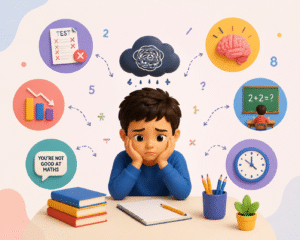
One of the biggest reasons for Math anxiety in children is the fear of making mistakes. When kids are scolded for making mistakes in general, compared with others, or forced to solve problems quickly, they begin to feel that maths is scary and tend to start avoiding it by one way or the other.
Another key reason for Math anxiety is overindulging a child in multiple extra-curricular activities like sports classes, music classes, language classes etc at the same time. If you look around and observe the children in your neighborhood, you will find that most kids are running a packed schedule. They wake up at 6 am and school starts at 7:30 am, they come back by 3 pm and their classes for sports or music start from 4 pm until 7 or 8 pm. By this time kids are so exhausted that they do not get any time to relax or sleep, so they cannot spend quality time on Maths homework. Remember that Maths needs regular practice with a relaxed mind, if a child has to develop a good hold.
Signs Your Child has fear of Maths
While there can be many signs and as a parent you are the best judge, allow me to focus on three main signs that we most commonly see in young children
- Avoiding Maths Homework – One of the biggest signs of Math Phobia in children is that they start avoiding homework in many forms. Your child may delay homework, say they forgot the worksheet, or make other excuses when it is time to practice Maths. Some children may sit with the book open but not start. This usually happens because they are afraid of making mistakes or feeling embarrassed.
- Use of calculators even for simple arithmetic calculations – This is a clear sign that a child is not confident in Maths and is afraid of numbers. A child who is not afraid of Maths would always prefer to do arithmetic calculations in his rough notes or even mentally without using a paper or a pen
- Avoiding to participate in Maths quizzes and puzzles – Try giving a few Math based puzzles like sudoku or some pattern related questions. If he takes interest and attempts with fun and confidence, there is no issue. But if he hesitates and tries to avoid these quizzes or questions even in the safe home environment where no one is judging him, it is evident that he is afraid of Maths.
Effective Ways to Overcome Fear of Maths
If your child has already developed fear or anxiety for Maths, then you must prioritize and take some immediate remedial actions before the problem grows to a level where it gets more difficult to solve. Here are the top two actions that I recommend to overcome fear of Maths.
- Promote Positive Mindset – Parents must comfort the child that he is not alone in this situation and that he will receive complete emotional support from them. We need children to open up and discuss their problems with their parents freely, without the fear of backlash. You will see that once the child gains the confidence to raise issues at home, he will start opening up, and this is the first important step. At the same time, parents should help children understand the importance of mathematics in everyday life and future academic success, so that they view learning as a valuable skill rather than just a subject. The focus should be on the effort and discipline the child is putting into learning Maths, not just the exam scores. Mistakes should be treated as stepping stones in this journey, and in life.
- Take professional guidance from a good teacher – Professional help from a trained Maths teacher should be taken at the right time before it gets too late. Choose the trainer wisely, and align clearly with the trainer on what problem you are trying to solve. Do not expect overnight results. The trainer must have an experience to engage positively with the kids. Remember that both parents and trainer must be patient, since the foundation in terms of basic Math concepts and arithmetic calculation would need to be build first, before advancing to logical reasoning or word problems.
Tips for Parents to Make Maths Fun and Easy
- Practical learning (relate Maths with real world) – For young children, helping them connect Math with real day to day examples around them is the most effective way to make learning Maths full of fun. Simple things like asking a 5 year old to bring round objects from the kitchen (and let him identify it in fun way like plates or bowls), or counting the number of doors in the house, can go a long way in making Maths fun.
- Introducing simple quizzes in free time – As mentioned earlier in this article, engaging kids in Mansi based puzzles like Sudoku is a great way of promoting interest in Maths. When a child learns Maths concepts in a gamified way, he will never get bored and look forward to it. Regular participation in Maths puzzles also strengthens logical thinking and analytical abilities which will go a long way in building a strong foundation.
- Explore alternate ways of learning Maths like Abacus classes and Vedis Maths tricks – Both Abacus classes and Vedic Maths courses are age-old proven techniques that make learning Maths full of fun. Children get a feeling that they are learning something new and different from what is taught in school’s traditional method of teaching. Both these methods allow kids to do basic arithmetic calculations much faster (up to 5x faster than regular methods) and this leads to high confidence. I would suggest choosing any one of these, not both so as not to confuse or overload the child.
As we close, I want to mention that this topic of removing Maths anxiety from kids is close to my heart. At Mathcruise this is our main mission and we feel proud that all our students love Maths and approach it in a fun and positive way. I must admit that the journey is not easy and we need to be very patient with the kids. However with the support from parents, we have seen great results in our students and this also reflects in Google reviews on our website. If you are looking to partner with us on this journey to make Maths a favorite subject for your child, reach out to us today to book a free assessment, and set your child on the right path to success and confidence.
I would also highly encourage you to explore the alternate methods of learning outside of regular school, and go through the details of how our specially curated Abacus course and Vedic Maths courses (both beginner and advanced levels) benefit children immensely in their growing years. If you can take this initiative now, you will provide a solid foundation to your child to become confident in everything that he does, not only academics.
Tanmay Gupta, a specialist in mathematics, possesses a deep passion for the subject. He has been involved with Mathcruise since its inception and takes pride in being a part of the growing Mathcruise family. Tanmay excels in both Abacus and Vedic Mathematics and is particularly interested in developing innovative methods to effectively engage with children, aiming to eliminate their fear of mathematics.